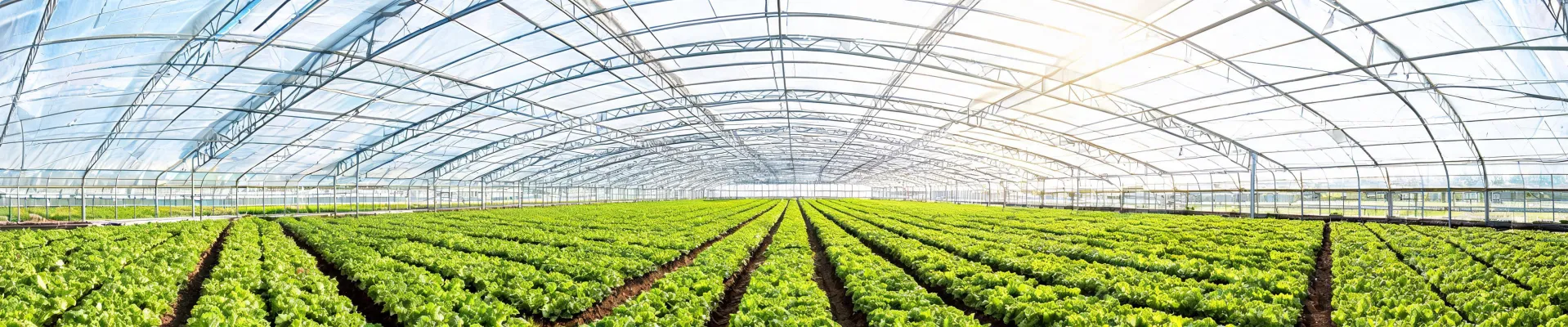
Do anti-drip, IR, and diffusion additives actually change anything, or is it the same roll with a longer label? They change three different things, and none of them is a general upgrade. Anti-drip manages water on the film surface. IR slows radiant heat loss at night. Diffusion spreads light through the canopy. A roll that carries all three is doing three jobs at once, which is useful only if your greenhouse has all three problems.
Most buyers get this backward. They treat the additive list as a trim level and pay for the longest label. The cheaper move is to name the failure first: dripping condensate on the crop, cold nights in a heated house, or shaded lower leaves in a tall crop. That order also sets the installation sequence, because the film stack has to be written correctly before anyone climbs the frame.
Three Additives Three Separate Jobs
Anti-drip is a wetting agent. It reduces surface tension so condensation spreads into a film and runs down the plastic instead of hanging in droplets. The same chemistry can be sprayed onto the film or built into the center layer. Droplets cost you light, and when they drop onto plants they create disease pressure. An anti-fogging component may be added to keep fog from forming during early morning and late afternoon.
IR is a different job. The additive traps radiant heat inside the house so it does not escape through the roof at night. In a heated greenhouse that is a fuel question; in a seasonal tunnel it is a frost and crop-development question. IR does not make light, move water, or fix a dripping roof.
Diffusion is about the shape of the light, not the amount of it. A diffusing film spreads incoming light so more reaches lower leaves and the top of the canopy is less likely to scorch. It matters most with tall crops such as tomatoes, cucumbers, and peppers, where the top of the plant can shade the fruit zone below. Diffused light has also been associated with less fungus spore development and reduced insect propagation.
Day One Name the Real Problem
Day one is diagnosis, not shopping. Walk the house in the morning when the film is wet and the crop is under stress. If the roof is shedding water onto plants, start with anti-drip. If the house is heated through winter and the roof is losing heat at night, start with IR. If the crop is tall and the lower canopy is pale or scorched, start with diffusion. A house can have more than one problem, but rank them before you price them. That is a repair list, not a wish list.
Suppose you run two houses. One is a heated tomato house that runs all winter; the other is an unheated seasonal tunnel for spring greens. The heated house may earn an IR layer because nighttime heat loss is a recurring cost. The seasonal tunnel may earn anti-drip because the crop is short, the roof is low, and droplets land on the plants. Putting diffusion on the spring tunnel because the tomato house has it is how buyers end up paying for a function that never gets used.
None of these additives is a yield guarantee. They change a condition, whether water behavior, heat loss, or light distribution, and the crop responds to that condition. That is a narrower claim than the label suggests, and it is the one you can check.
Step One Stop Condensate Drips
If condensate is the problem, you have two routes. A sprayed anti-drip treatment goes on the film surface and changes how water beads. An incorporated additive is built into the center layer when the film is made. The sprayed route can be applied to existing plastic; the incorporated route has to be specified when you order. Both work on the same principle: lower the surface tension so water sheets and flows instead of hanging in drops.
The effect is finite. Anti-drip is not a permanent surface property, so check the surface before you assume it is still active. The payoff shows up in two places: more light through the plastic because the surface is not covered in droplets, and less free water landing on foliage and fruit.
Ask for the anti-fog option separately. Anti-drip controls droplets on the film; anti-fogging controls fog in the air, which shows up in the early morning and late afternoon. That is a related benefit, but it does not ventilate the house.
Install Week Specify the Film Stack
Install week is where the diagnosis becomes a spec. Before you accept a quote, make the seller write the stack layer by layer: outer layer, inner layer, and what each layer carries. Anti-drip film is not a specification. It can mean a film with the additive in the center layer, or a film that will be sprayed after installation. Those are different products with different maintenance.
Ask three questions in writing. Is the anti-drip incorporated or sprayed? How many layers are in the assembly? Which layer carries the IR additive, if any? If the answer to the last question is vague, stop. In a double-layer house the IR film has a defined position, and a supplier who cannot name it is not selling you a stack.
This is also the moment to separate a manufacturer claim from an extension recommendation. A supplier can describe what the additive is designed to do. Your job is to match that description to the failure you found on day one. Ask for current documentation as well, because older additive guidance is a description of how the products behave, not a current price or energy guarantee.
Install Day Place the IR Layer
On install day, the IR film goes on the inside layer of a double-layer poly house. That is an installation requirement, not a preference: the inner layer is the surface that faces the crop and holds radiant heat in the house. Put it on the outside and the additive is on the wrong side of the air gap.
The mechanism is simple enough to check against the building. The additive reduces the escape of radiant heat from inside the house at night. A heated house feels it in the fuel bill; an unheated house feels it in the crop, especially when the roof is losing heat fastest. Extension guidance also notes that IR film has been associated with better color or compactness and faster development, most likely because plant tissue stays warmer at night.
Do not turn that into a promise. Color, compactness, and timing are crop and season responses, not a guaranteed outcome from a film label. What you can verify on install day is placement, layer count, and whether the inner layer is the IR product. The crop response is something you observe later.
Three Months In Check Diffusion
The first week after installation is a water check, not a light check. Look at the film in the morning: water should be sheeting and running down, not hanging in beads. If beads are still there, the anti-drip surface is not working as specified, and you should raise it with the supplier while the install is fresh.
Three months in is when diffusion becomes visible. Pull the canopy apart and look at the lower leaves on a tall crop. Are they receiving filtered light, or are they in the shadow of the upper wire? Is the top of the canopy scorched on bright afternoons? Diffusion is designed to spread light into the crop rather than deliver a hard beam to the top leaves, which is why the effect shows up in tall crops before it shows up in a bed of lettuce.
By the end of the season, compare disease and insect pressure along with yield. Diffused light has been associated with less fungus spore development and reduced insect propagation, so a house that stays cleaner through a humid stretch is a more useful signal than a single week of color. Suppose you run two houses, one with diffusion and one without. Keep the crop, irrigation, and ventilation as close as you can before you draw a conclusion.
The tradeoff is real. A short-season tunnel with a low canopy may never show a diffusion benefit, because the light does not have to travel far to reach the leaves. A tall, long-season crop is where the additive has a job. Paying for diffusion on a house that finishes quickly is not a mistake in the film; it is a mismatch between the film and the crop.
Before you order, confirm one line on the quote: whether the anti-drip is incorporated or sprayed, and which layer carries it. That single line tells you what you are actually buying, because the same phrase covers two different products and two different maintenance schedules.

Leave a procurement question
Comments are not purchase orders. Use the inquiry form for company and order details.