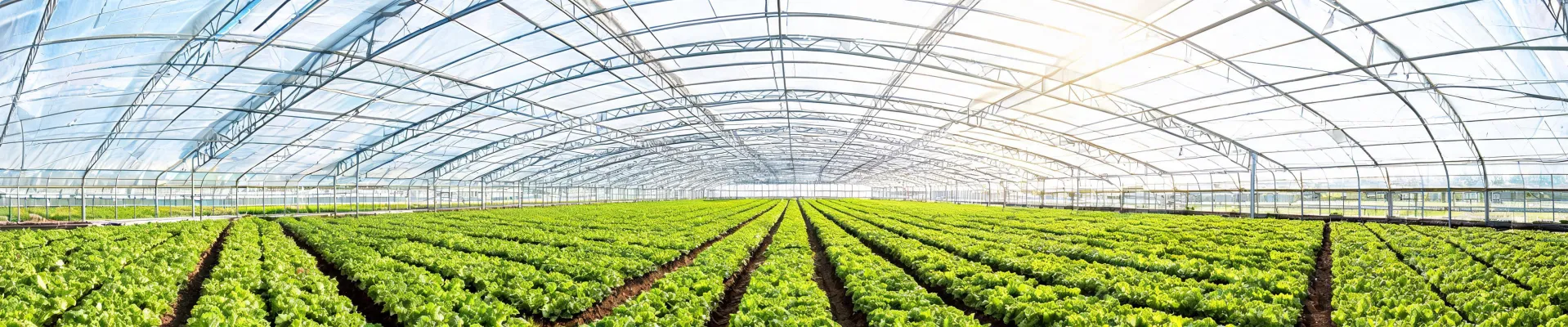
A roll of greenhouse plastic looks like a commodity. Same width, same thickness, same color on the outside of the roll. Then the house goes up, the bees go in, and the crop tells you what you actually bought. Pick the film on price or mil thickness alone and the failure shows up in the two places that are hardest to fix after the fact: pollination and delivered light.
In a bee-pollinated winter house, a film that screens out UV can leave pollinators without the cue they work by, and a film chosen for the wrong additive package can put less light on the canopy than the number on the label suggested. Re-covering mid-season costs the film twice, the labor twice, and a stretch of crop time you cannot recover. For a house that leans on bees, UV transmission belongs in the buying spec before the highest PAR number does, and the price you pay for it is pest pressure.
Why the Wrong Film Costs a Season
Imagine a grower covering a seasonal tunnel in late fall, planning to bring in managed bees for a February crop. The roll gets ordered by width, length and thickness because those are the three numbers on the quote that are easy to line up side by side. Nobody asks what additive package the film carries or whether it passes UV. The house goes up clean and tight, the bees go in, and set is uneven at one end while the other end looks normal. That is the pattern you get when the covering fights the pollination plan you already paid for.
The mistake is treating greenhouse plastic as a commodity roll, something you buy by the foot the way you buy tarp. A polyethylene greenhouse film is a formulation: base resin plus UV stabilizers, infrared and anti-condensate additives, diffusion packages, or photoselective pigments, and each one changes what reaches the crop. Get that wrong and the shortfall rarely lands on day one. It shows up as a canopy that runs a little thinner than last year, a pollinator that never quite works the far rows, or a March decision to re-cover because the house is not performing. Compare film by additive class and optical role first, price second, and the order of your decisions starts to match the order of the consequences.
The UV Tradeoff for Bee-Pollinated Greenhouses
Here is the conclusion worth holding onto. If bees are part of how the house gets pollinated, UV transmission is a selection constraint, not a bonus. Bees use UV as a navigation cue, so a film that lets some of the UV part of the spectrum through may be important for them to work the house properly. A covering that screens out that band is screening out information the pollinator uses.
Most people assume a UV-blocking film is the safer buy because it cuts pest pressure; in fact, in a bee-pollinated house it can undercut the exact behavior the crop depends on. The same blocking property that reduces whiteflies, thrips, aphids and other insects, and that can help control some fungal diseases, is the property that may leave bees without their cue. Both effects are real. You are not choosing between a good film and a bad one, you are choosing which effect you want to live with.
Work outward from the pollination method. If bees are essential, ask the supplier for a film that allows some UV through, then budget the pest side as a management job rather than pretending it disappeared. If you want the insect suppression and you are not relying on bees, the blocking film is doing real work for you. General guidance describes the mechanism, not a blocking percentage, so the actual UV behavior has to come from the specific product data sheet.
Why Equal Light Numbers Hide Different Films
PAR transmission, the light plants actually use, varies with the type of additive in the film rather than with one headline figure. Cited typical values run about 88 to 91 percent for UV-stabilized film, 82 to 87 percent for IR-AC film, and 77 to 88 percent for IR-AC film with diffusion. Read those as categories with overlap, not as a league table. A diffusion film gives up some raw transmission on purpose in exchange for spreading light deeper into the canopy, which is a different goal from maximizing the number.
Most people assume the light percentage printed on the roll is the light the crop gets; in fact, the additive package and your field conditions decide what arrives at the leaf. Dust, smog and plastic deterioration all pull delivered light below the spec-sheet expectation. That printed percentage is really just a paper number. It describes what a sample of the film did when it was measured, not what is landing on your canopy in March after a winter of grit and film aging.
The practical reason a few points matter: one percent more light is roughly one percent more growth during winter or in cloudy weather. That rule of thumb is why some growers replace plastic annually just to gain a few percent during the short days of winter. It is also why buying on a printed number alone misses the point, because a film that tests high but sits under dust may deliver less than a slightly lower-rated film that spreads light better for your crop.
When Red Film Shade Makes Sense
The easy mistake here is assuming any film that lowers PAR is a bad buy. Photoselective films absorb or reflect specific wavelengths, and that behavior can enhance plant growth, suppress insects and diseases, and affect flower development. Red films of the type cited in extension guidance reduce PAR and create a shading effect, and they have also been shown to improve rose yield and quality.
Guessing wrong here cuts both ways. Reject every photoselective film on principle and you may pass over a covering that fits a specific crop and purpose. Buy one without matching it to the crop and you have paid for shade in a house that needed maximum light through a short winter. Treat those red-film results as what they are, outcomes for a named crop in a specific trial, and do not carry a rose result over to tomatoes or bedding plants. For a light-hungry winter crop, a shading film is not the default.
What Would Overturn the Bee-First Advice
The bee-first rule breaks when there are no managed bees to protect. If pollination is wind-driven, mechanical, or handled by hand, or if the crop sets fruit without a pollinator visit, then UV transmission buys you nothing and UV blocking may be the stronger choice. The same applies when insect pressure or a fungal problem is the dominant cost in the house and the insect-suppressing effect of a blocking film is worth more than a navigation cue nobody uses.
So the advice is conditional, not universal. Applying it to every greenhouse has a cost: unnecessary insect pressure in a house that never needed the UV, or missed suppression in one that did. Where the line falls depends on your crop, your pest history, and whether a pollinator is doing paid work in that house.
What to Confirm With the Supplier Before Ordering
Write the use case into the quote request and keep the answer with the purchase record. Ask whether the film is intended to pass some UV or to block it. Ask which additive class it belongs to, whether UV-stabilized, IR-AC, diffusion or photoselective, because that class is what sets the transmission range. Ask what basis the supplier uses for the PAR figure and whether it is a measured value for that product. Ask how dust and normal film deterioration are expected to affect the installed covering over its service life.
Here is the objection that usually comes last: if I let UV in for the bees, do pests and disease get worse? At least partly, yes. That is the tradeoff, not a side effect anyone has engineered away. So put the pollination method in the quote request, ask what the film does to UV, and price the scouting and the beneficial-insect work as part of the decision. If bees carry your crop, choose UV transmission on purpose. If they do not, take the pest suppression and stop paying for a navigation cue nobody uses.

Leave a procurement question
Comments are not purchase orders. Use the inquiry form for company and order details.